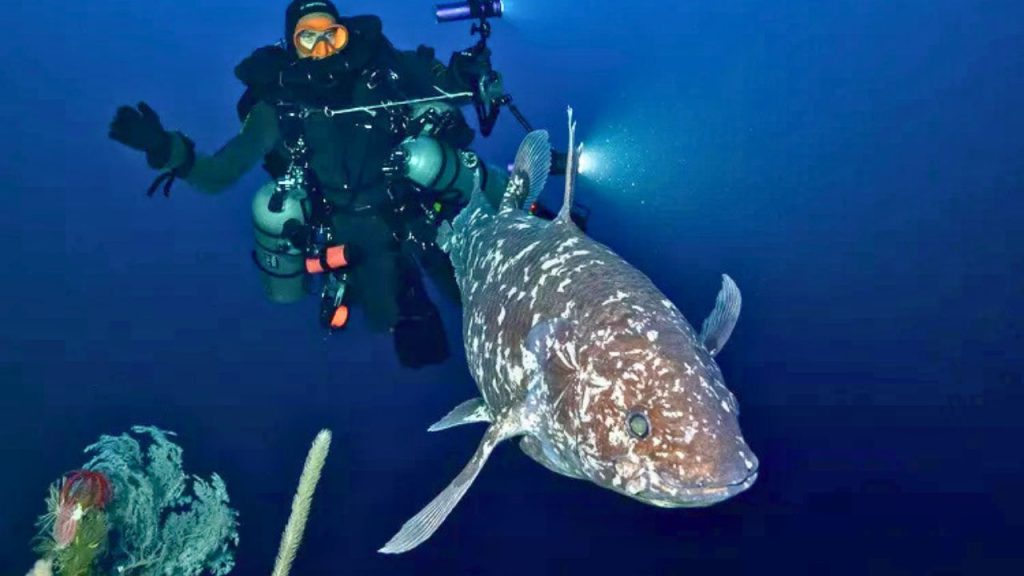
Coelacanths are fish that seem to come straight from another time. For decades, they were known only through fossils dating back over 400 million years, making them older than the dinosaurs. Then, in 1938, a living specimen was caught off the coast of South Africa, stunning scientists worldwide. This discovery challenged long-held ideas about evolution and extinction.
What makes coelacanths so unique? How have they survived virtually unchanged for hundreds of millions of years? This article explores the life, biology, and ongoing mystery of these ancient fish.
What Are Coelacanths?
Coelacanths belong to a rare group of lobe-finned fish (Sarcopterygii), which differ from the more common ray-finned fish (Actinopterygii). Their paired fins resemble limbs more than fins, with bone structures that look like early versions of limbs in land animals. This anatomical feature links coelacanths closely to the evolutionary ancestors of amphibians, reptiles, and mammals.
Two living species of coelacanths exist today:
- Latimeria chalumnae — Found mainly around the Comoros Islands in the western Indian Ocean.
- Latimeria menadoensis — Discovered in 1997 near Indonesia.
Both species inhabit deep marine environments, usually between 150 to 700 meters below the surface. They prefer underwater caves and volcanic slopes, where light barely penetrates.
A Living Fossil: What Does That Mean?
Coelacanths are often called “living fossils” because their body structure has changed little since the Devonian period, roughly 360 million years ago. Fossil records show remarkable similarity between ancient coelacanths and modern ones. Their slow evolution and stable morphology provide a rare glimpse into early vertebrate history.
The term “living fossil” can be misleading, as it might imply that the species has stopped evolving. In reality, coelacanths have undergone genetic changes but retain many ancestral traits. Their survival through mass extinctions, including the event that wiped out the dinosaurs 66 million years ago, makes them a subject of intense scientific interest.
How Were Coelacanths Rediscovered?
Before 1938, coelacanths were known only from fossils, so scientists believed they had gone extinct around 66 million years ago. That year, Captain Hendrik Goosen caught a strange fish off the coast of South Africa. Marjorie Courtenay-Latimer, a museum curator, identified it as something unknown and contacted ichthyologist J.L.B. Smith. Smith confirmed the find as a coelacanth, shocking the scientific community.
Since then, researchers have found more specimens in the Indian Ocean, Madagascar, and Indonesia. Modern technology, including submersibles and underwater cameras, has helped observe their natural behavior without disturbing their habitat.
Unique Biological Traits of Coelacanths
- Electroreception: Coelacanths have a rostral organ in their snout that detects electrical signals from prey, helping them hunt in dark waters.
- Intracranial joint: Their skull has a hinge that allows the front part to lift while opening the mouth, increasing bite force.
- Viviparity: Coelacanths give birth to live young after an estimated 13-month gestation period, unlike many fish that lay eggs.
- Low metabolism: They move slowly and expend minimal energy, which may contribute to their long lifespan (estimated up to 60 years).
- Lobed fins: The fleshy fins resemble limbs and are considered a link between fish and early tetrapods, which eventually moved onto land.
Why Are Coelacanths Important?
Scientists study coelacanths to understand vertebrate evolution, especially the transition from water to land. Their genome sequencing, completed in 2013 by the University of Chicago and collaborators, revealed unexpected links to tetrapods. The genome also showed slow evolution in some genes, supporting the idea of their “living fossil” status.
Coelacanths also provide insight into deep-sea ecosystems, which remain largely unexplored. Their presence hints at a complex marine environment that has persisted over geological time.
Conservation Challenges
Coelacanths face threats from habitat destruction, accidental fishing bycatch, and limited distribution. Though protected by international laws and national regulations in countries like South Africa and the Comoros, their deep-sea habitat makes monitoring difficult.
Scientists encourage responsible fishing practices and habitat preservation. Continued research helps raise awareness of their ecological role and vulnerability.
Personal Encounters and Stories
Marine biologists who have seen coelacanths in their natural environment often describe a surreal experience. Dr. Mark Erdmann, who discovered Latimeria menadoensis, noted the fish’s slow, graceful movements in dark caves. Observers say coelacanths seem almost like living relics, carrying the whispers of an ancient world beneath the waves.
What Lies Ahead for Coelacanth Research?
Advances in deep-sea exploration technology promise to reveal more about coelacanth behavior, reproduction, and ecology. Scientists hope to track their movements using tagging devices and study their population genetics to ensure long-term survival.
Each discovery reminds us how much remains unknown about the ocean’s depths and the species that have survived for eons.